Thursday, April 28, 2011

Furniture Tip-Overs: A Threat Revealed!


When my son became a preschooler, I took a sigh of relief and thought to myself, "Phew, we made it through the climbing stage unscathed!" I felt so blessed that my son was never "a climber" and assumed he never would be. Well, my confidence was shattered not to long ago when I witnessed him opening my dresser drawers. When I asked what he was doing, he nonchalantly explained that he wanted to reach a movie that my husband or I left on top of the dresser.

 I immediately sat him down and explained the consequences of what could have happened had he proceeded with his plan. I couldn't help myself as a Pediatric OR Nurse from telling him the injuries he would have sustained and the time he would have had to spend in the hospital (meaning No Preschool, No Swim Lessons, No Summer Vacations, No Playing Baseball etc). Of course I refrained from sharing my professional experiences of those children who ended up with permanent brain damage or those who died from their extensive injuries. 

How much he absorbed, not so sure. Do I trust that my words were enough to deter him from doing it again? Not at all! Words are never enough when in competition with a child's desire, determination, and curiosity.


Read the article below for useful information and safety tips to prevent this tragedy from happening in your home!


The hidden home hazard…

The U.S. Consumer Product Safety Commission (CPSC) estimates that between 2000 and 2006 there were at least 180 deaths related to tip-overs of furniture, televisions or appliances.  Most of theses deaths, 80 percent of them, involved children younger than 10.  In 2007, the CPSC identified this issue as one of the top five hidden home hazards.  Children can be seriously injured or killed as result of climbing onto, falling against or pulling themselves up on shelves, bookcases, dressers, TV tables and other furniture. 
Whether you have a baby learning to stand, an unsteady toddler trying to climb, or a fearless preschooler who still doesn’t quite understand balance, furniture tip-overs are a real and hidden danger for children. 
Regardless of your child’s abilities and limitations, top-heavy furniture, TVs and appliances can tip over and seriously injure young children. There are many easy-to-install devices that anchor furniture to the wall, making furniture more stable and tip-over resistant. These devices are designed for dressers, wall units, and anything your child might try to climb.
Top safety tips to help prevent tip-overs:
  • If a piece of furniture is unstable or top-heavy, secure it to a stud in the wall using brackets, braces, anchors, or wall straps. Large items such as TVs, microwaves, fish tanks, bookcases, heavy furniture, and appliances can topple off stands and fall on children. 
  • If you have a newer flat screen TV, make sure it’s properly anchored to the wall.
  • Read the manufacturer’s instructions for tips or warnings regarding placement of your TV or furniture.
  • Keep heavier items on lower shelves or in lower drawers.
  • Don’t keep remote controls, candy, toys, or other items that attract children on top of furniture, as your child might be enticed to reach for these items.
  • Supervise young children at all times. Nothing can take the place of active supervision.         
Don’t underestimate the possibility of a small child being crushed by unsteady furniture.
For more information regarding furniture tip-overs and entrapment, or other information on injury prevention, log on to www.safekidsgf.com or send us an e-mail at safekids@altru.org.

Tuesday, April 26, 2011

Top "10" Hazardous Household Chemicals

Top "10" Hazardous Household Chemicals

by Richard Alexander

AIR FRESHENERS

Most air fresheners interfere with your ability to smell by coating your nasal passages with an oil film, or by releasing a nerve deadening agent. Known toxic chemicals found in an air freshener: Formaldehyde: Highly toxic, known carcinogen. Phenol: When phenol touches your skin it can cause it to swell, burn, peel, and break out in hives. Can cause cold sweats,convulsions, circulatory collapse, coma and even death.

AMMONIA

It is a very volatile chemical, it is very damaging to your eyes, respiratory tract and skin.

BLEACH

It is a strong corrosive. It will irritate or burn the skin, eyes and respiratory tract. It may cause pulmonary edema or vomiting and coma if ingested. WARNING: never mix bleach with ammonia it may cause fumes which can be DEADLY.

CARPET AND UPHOLSTERY SHAMPOO

Most formulas are designed to over power the stain itself, they accomplish the task but not without using highly toxic substances. Some include: Perchlorethylene: Known carcinogen damages liver, kidney and nervous system damage. Ammonium Hydroxide: Corrosive, extremely irritable to eyes, skin and respiratory passages.

DISHWASHER DETERGENTS

Most products contain chlorine in a dry form that is highly concentrated.# 1 cause of child poisonings, according to poison control centers.

DRAIN CLEANER

Most drain cleaners contain lye, hydrochloric acid or trichloroethane. Lye: Caustic, burns skin and eyes, if ingested will damage esophagus and stomach. Hydrochloric acid: Corrosive, eye and skin irritant, damages kidneys, liver and digestive tract. Trichloroethane: Eye and skin irritant, nervous system depressant; damages liver and kidneys.

FURNITURE POLISH

Petroleum Distillates: Highly flammable, can cause skin and lung cancer. Phenol: (see Air fresheners, Phenol.) Nitrobenzene: Easily absorbed through the skin, extremely toxic.

MOLD AND MILDEW CLEANERS

Chemicals contained are: Sodium hypochlorite: Corrosive, irritates or burns skin and eyes, causes fluid in the lungs which can lead to coma or death. Formaldehyde: Highly toxic, known carcinogen. Irritant to eyes, nose, throat, and skin. May cause nausea, headaches, nosebleeds, dizziness, memory loss and shortness of breath.

OVEN CLEANER

Sodium Hydroxide (Lye): Caustic, strong irritant, burns to both skin and eyes. Inhibits reflexes, will cause severe tissue damage if swallowed.

ANTIBACTERIAL CLEANERS

may contain: Triclosan: Absorption through the skin can be tied to liver damage.

LAUNDRY ROOM PRODUCTS

Sodium or calcium hypocrite: Highly corrosive, irritates or burns skin, eyes or respiratory tract. Linear alkylate sulfonate: Absorbed through the skin. Known liver damaging agent. Sodium Tripolyphosphate: Irritates skin and mucous membranes, causes vomiting. Easily absorbed through the skin from clothes.

TOILET BOWL CLEANERS

Hydrochloric acid: Highly corrosive, irritant to both skin and eyes. Damages kidneys and liver. Hypochlorite Bleach: Corrosive, irritates or burns eyes, skin and respiratory tract. May cause pulmonary edema, vomiting or coma if ingested. Contact with other chemicals may cause chlorine fumes which may be fatal.

Monday, April 25, 2011

Bath Seat Safety: A Lesson Learned!

For the past week I have nursed my entire family, including myself, back to health from the horrid stomach flu. Apparently, I started it, then my 7 month old daughter came down with it, and then my 4 year old son. I have been barely able to keep up with meeting the needs of 2 sick kids,the house, laundry etc. 

And then let me preface that I knew better as a mom, and a Pediatric Nurse, and not to mention it's written all over the freakin' bath seat.

I was giving my daughter a bath with her in her bath seat and my son was taking a nap in my bedroom. All of a sudden my son screams bloody murder and I go flying into my room. Just as I reach my bedroom, I hear plastic against the bathtub and a splash. I go flying back into the bathroom to see my daughter out of her bath seat and completely submerged under water. I grab her out of the water and with some sputtering she was able to catch her breath.

I almost collapsed from the adrenalin rush from knowing how close I came to losing my daughter. I called my mom and husband hysterical saying "I almost killed my daughter" and "I am such a terrible mother!" They kept reassuring me that they would have done the same thing but I KNOW better. I KNOW it happens because I am nurse, a PEDIATRIC nurse and yet I did it anyway. 

I swear an angel was watching over me and my daughter. So PLEASE although it may be tempting to just step a way for a second, learn from my close call, and if the need is that urgent, grab your child out of the bath seat before leaving them in there!


Saturday, April 23, 2011

A Brand Name to Trust? See For Yourself....


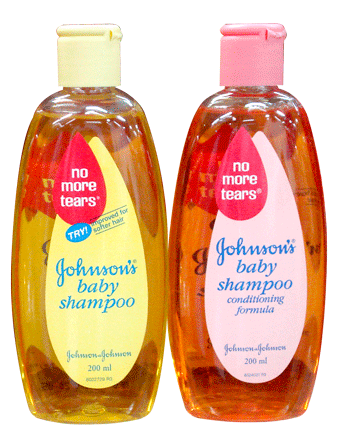
Johnson & Johnson and Wal-Mart Sued for Selling Toxic Baby Shampoo


By Sarah Pierce

Baby Shampoo
If you purchased Johnson & Johnson’s Baby Shampoo or Wal-Mart brand Equate Tearless Baby Wash, you may want to stop using it. A class action lawsuit has been approved this month that claims these products may contain a toxin linked to cancer.

The class action lawsuit, filed earlier this year, accuses Johnson & Johnson and Wal-Mart Stores of selling shampoo and baby wash that allegedly containsmethylene chloride, an ingredient banned by the FDA in cosmetics because it’s linked to cancer. The law firm that filed the lawsuit is also investigating Target’s Night-time Bath and Body Wash, which is not currently named in the suit.

A third Johnson & Johnson plant is now also under investigation for alleged quality concerns. The new Johnson & Johnson plant is one that manufactures Pepcid and Mylanta among other products. You can read the details on that investigation at Legafi.

Top Class Actions will keep you informed of the Johnson & Johnson class action lawsuit. If/when it settles we'll include it in our free monthly newsletter. Please make sure to sign up for it below. That way you won't miss any of the big class action lawsuits that are currently being litigated.

Fill out your e-mail address
to receive our FREE newsletter!
E-mail address:
First Name:
State or Province:

Updated August 10th, 2010

All class action and lawsuit news updates are listed in the Lawsuit News section of Top Class Actions
LEGAL INFORMATION IS NOT LEGAL ADVICE
Top Class Actions Legal Statement 
©2008 - 2010 Top Class Actions® LLC
Various Trademarks held by their respective owners.

Friday, April 22, 2011

A Safer Home

A couple of weeks ago I had a 3 year old come to the OR because she swallowed a toxic substance that was left on the bathroom counter. The parents were so guilt stricken and repeated that she never showed ANY interest or curiosity before. Nor, did they think she could reach it.

Most people think by the time children reach 3 or 4 years old, they no longer are at risk because they are passed the stage of putting things in their mouth. Although, they are indeed passed that stage, they are now curious and problem solving individuals. Most cases of accidental ingestion occur in children 5 years and younger.

The parents I see in these situations are not neglectful parents, parents who just underestimated their child's curiosity, determination, and physical ability to access these harmful items.

I am just so grateful I have never had to walk in these parent's shoes because I use safe and non-toxic products!